
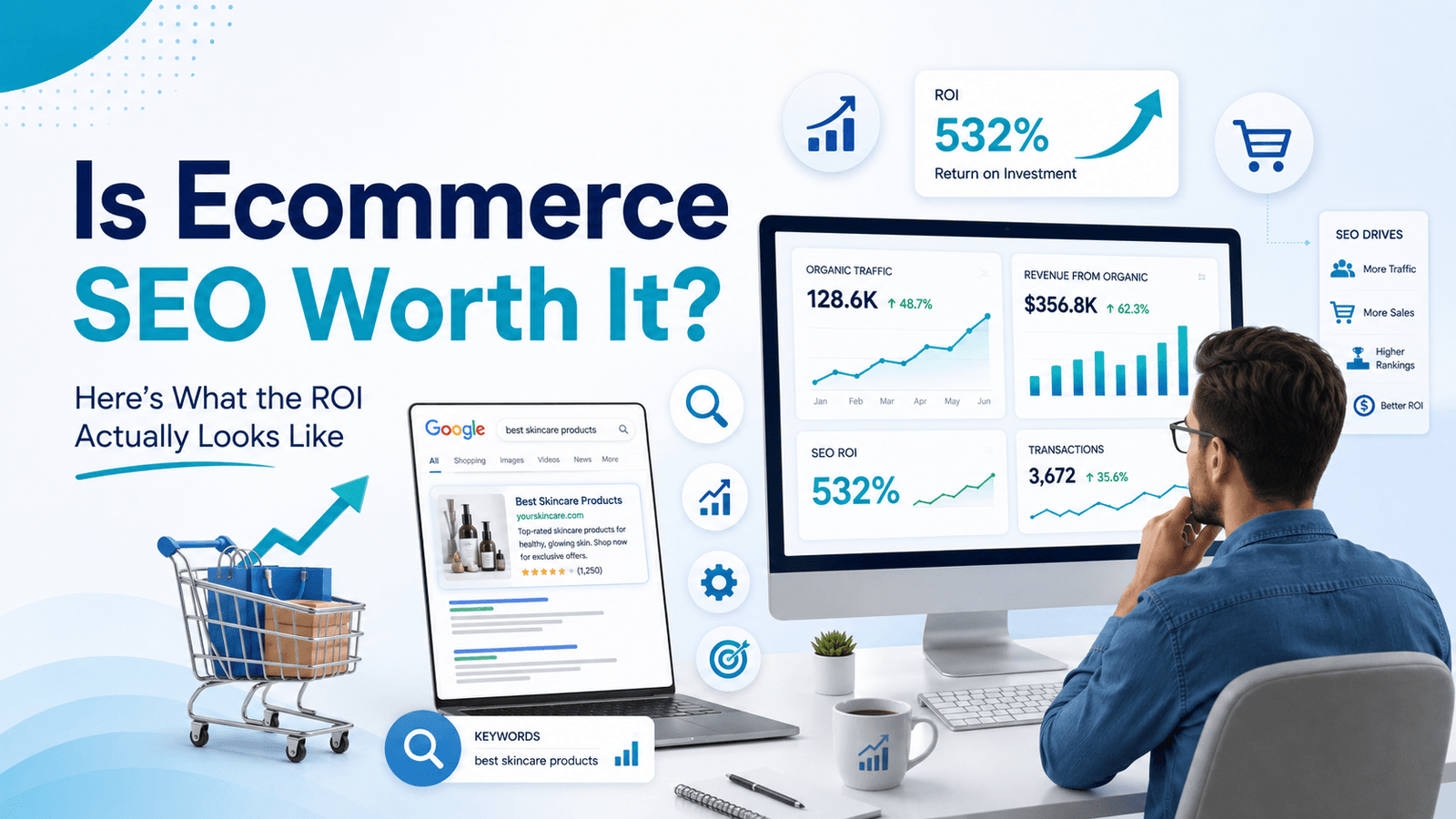
Somewhere around month two of an SEO campaign, almost every store owner has the same thought: is this actually working, or am I just paying someone to write blog posts and fiddle with meta tags? It’s a fair question. Paid ads hand you a number the same day you spend the money. SEO gives you quiet for a while, then, if it’s done right, a curve that keeps climbing long after you’ve stopped thinking about it. The honest answer to “is ecommerce SEO worth it” is yes, but only if you understand what kind of investment you’re actually making.
Why This Question Even Comes Up?
PPC feels safe because it’s legible. You spend ₹20,000, you get a dashboard showing clicks and conversions, and the math is right there in front of you. SEO doesn’t offer that same instant feedback loop, and a few months into a retainer, a lot of business owners start wondering whether the money would work harder somewhere else. That doubt is reasonable. It’s also usually a sign the timeline hasn’t been explained properly, not a sign SEO isn’t working.
SEO and Paid Ads Are Solving Different Problems
Paid search is rented traffic. The moment you stop paying, the visitors stop coming, full stop. Organic search is closer to owned media: once a product or collection page earns a ranking, it keeps pulling in visits without a per-click bill attached. In my experience running ecommerce SEO campaigns at SERP Shout, this is the single biggest thing clients underestimate going in. They compare month-one SEO cost to month-one PPC cost and assume SEO is the worse deal, without accounting for the fact that a page ranking well in month eight is still ranking, and still converting, in month fourteen with no extra spend.
That doesn’t mean one replaces the other. Plenty of healthy ecommerce stores run both, using paid search for immediate demand capture while SEO builds the asset that keeps paying out after the ad budget gets reallocated elsewhere.
What the Traffic Numbers Actually Show?
Across recent ecommerce benchmark studies (Similarweb’s 2025 report among them), organic search consistently lands somewhere between roughly a third and just over 40% of total ecommerce traffic, usually the largest non-branded acquisition channel a store has. It also tends to convert at a healthy clip: organic visitors generally arrive with clearer purchase intent than social or display traffic, and cost-per-acquisition benchmarks for organic search usually come in well below paid search once a page is established. Those numbers move around by vertical and by how established a domain already is, so treat them as a general direction rather than a guarantee for your specific store.
| Factor | SEO | Paid Search |
|---|---|---|
| Cost per visit over time | Trends toward zero marginal cost once a page ranks | You pay every time, indefinitely |
| Time to first results | Usually 3–6 months for early movement | Same day |
| What happens if you stop | Traffic decays slowly, a lot of it sticks around | Traffic drops to near zero almost immediately |
| Effect over time | Compounds as rankings and content build up | Resets every month, no carryover |
| Shopper trust | Many users actively skip paid results | Some shoppers distrust or ignore ads |
The Realistic Timeline (So You Don’t Quit at Month 3)
This is the part that actually determines whether SEO feels “worth it” to you. Here’s roughly what the first year looks like for a typical ecommerce site:
- Months 1–2: Foundation work. Technical audit, fixing crawl and indexing issues, keyword mapping, on-page fixes. Traffic is usually flat, sometimes even dips slightly as old, broken pages get cleaned up.
- Months 3–4: Early signals. Long-tail keywords start moving, a handful of collection pages climb into page one or two, organic sessions creep upward without a dramatic spike.
- Months 5–6: First measurable revenue. This is usually when SEO-attributed orders show up clearly enough in analytics that the client actually believes it’s working.
- Months 6–12: Compounding growth. Rankings stabilize, the content library starts pulling in secondary and related keywords on its own, and the ROI curve steepens noticeably.
- Year 2 and beyond: This is usually where SEO’s cost per order drops below paid search’s, because the early work keeps earning without new spend behind it.
I usually see the panic point land right around month three, which is exactly the wrong time to pull the plug. That’s typically the stretch right before the curve starts bending upward, not a sign the strategy has failed.
What “Worth It” Looks Like in Actual Numbers?
Here’s a simple way to think through the math without needing a fabricated case study. Say a store is spending a fixed monthly amount on Google Shopping or Search ads to get a certain volume of clicks. Every month that budget runs, that same volume has to be paid for again from scratch. Now compare that to a flat monthly SEO investment: once core pages are ranking, a meaningful share of that same traffic volume starts arriving without a matching per-click charge that month. The SEO investment doesn’t look cheaper on day one. It starts looking cheaper the moment rankings hold steady while the ad spend keeps resetting to zero every 30 days.
If you want to see this reasoning applied to actual client numbers rather than a hypothetical, SERP Shout’s case studies page walks through a few real before-and-after examples.
When Ecommerce SEO Genuinely Isn’t Worth It?
SEO isn’t the right first move for every store, and it’s worth saying so plainly rather than pretending it’s a universal fix. Consider holding off, or running paid channels first, if:
- Your store needs revenue in the next 60 to 90 days and can’t wait out the ramp-up period. SEO can run alongside paid, but it shouldn’t replace it when cash flow is tight right now.
- You’re mid-way through, or about to start, a full platform migration. Ranking work built on a site structure that’s about to change gets partly undone by the migration.
- Your catalog turns over faster than pages can realistically rank. If a product is gone in six weeks, the content built around it may not have time to earn visibility before it’s irrelevant.
- You’re not able to commit to at least six months of consistent work. Sporadic SEO, a month on and two months off, tends to waste the initial technical investment before it compounds.
How to Know Your SEO Investment Is Actually Working?
Don’t judge progress by whether you personally rank #1 for one keyword you searched from your phone. Track the broader picture instead:
- Organic sessions trending upward month over month, not just a single good week
- The number of keywords ranking in the top 10, not only the top 3
- Organic-attributed orders and revenue inside GA4 or your analytics platform of choice
- Total indexed pages climbing as new SKUs and collections get added and properly optimized
- Rankings and traffic specifically on category and collection pages, since these usually carry the highest-value transactional search demand

When to Bring in an Expert?
Consider bringing in outside help if you’ve been running SEO solo for six months with no real movement, if a recent redesign or replatform quietly tanked your rankings, or if you simply don’t have the bandwidth to keep up the audit-fix-monitor loop every month on top of actually running the store. That loop, the ongoing audit-fix-monitor cycle, is exactly what we handle for ecommerce clients at SERP Shout, and it’s where most of the compounding value gets built or lost.
SEO’s ROI is real, but it rewards patience and consistency over quick wins. If you want a clear-eyed look at where your store currently stands and what a realistic six-to-twelve month timeline would look like, get in touch with SERP Shout through our contact page for a free audit and strategy session.

I have 7+ years of experience in the digital marketing industry and have worked with e-commerce stores across multiple industries, including furniture, pet, tiles, and more. With result-driven approach, I have delivered measurable impact with SEO to over 100 businesses.